No products in the cart.

All Categories
All Categories
external
variable
grouped
simple
[fibosearch]
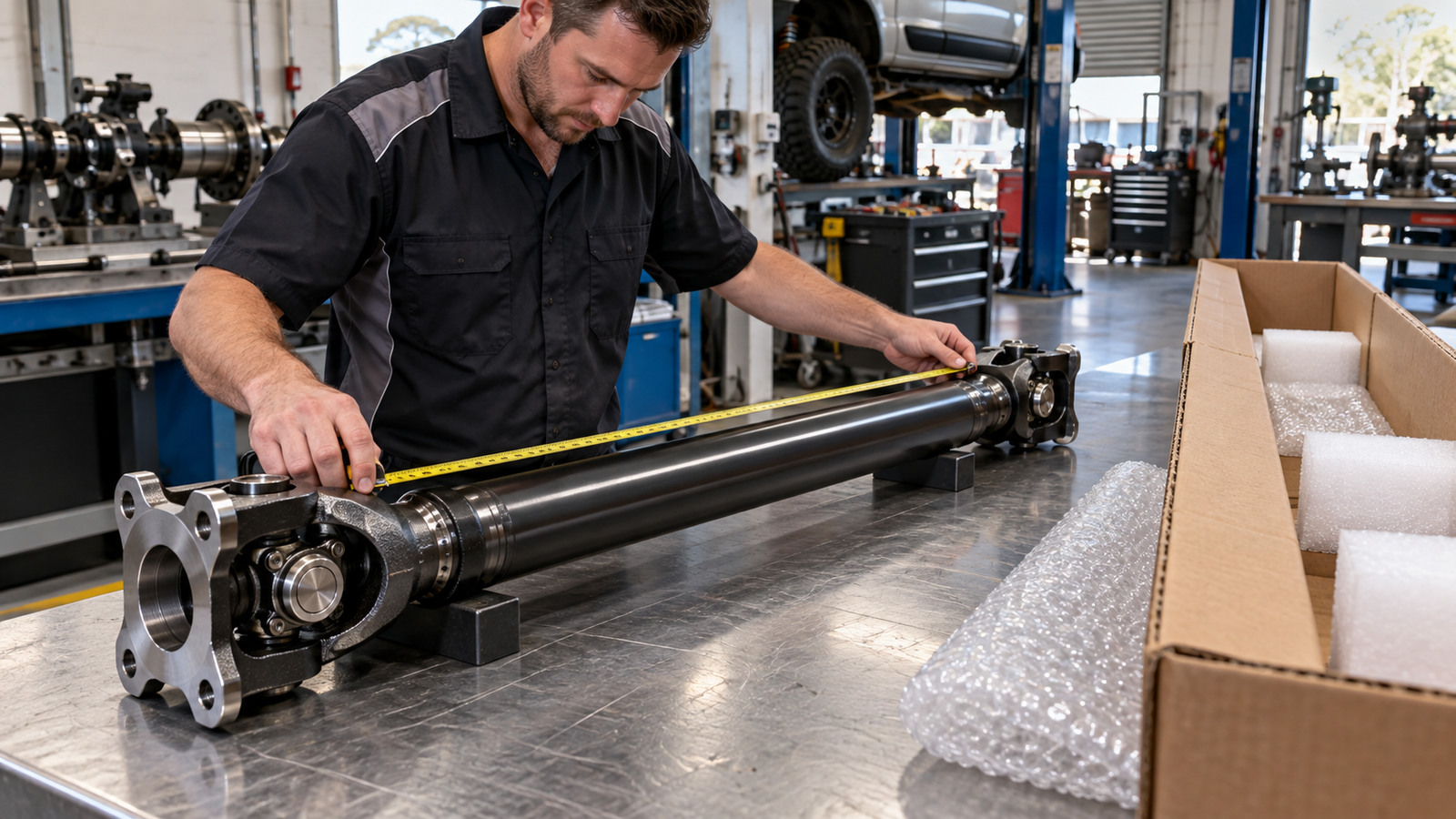
A custom tailshaft can be ordered from anywhere in Australia, because the measurements travel instead of the car. The shaft is built and balanced to those numbers, then freighted to you. Get the measurements and the end fittings right, and the rest is a delivery.
Custom drive shafts go out across Australia this way. Some orders come from owners with a modified vehicle. Others come from workshops ordering for a customer. The part travels and the vehicle stays where it is. So nobody is coming out to look at the car for you.
A shaft is made to measure rather than bought off the shelf. The length and the end fittings change from one build to the next.
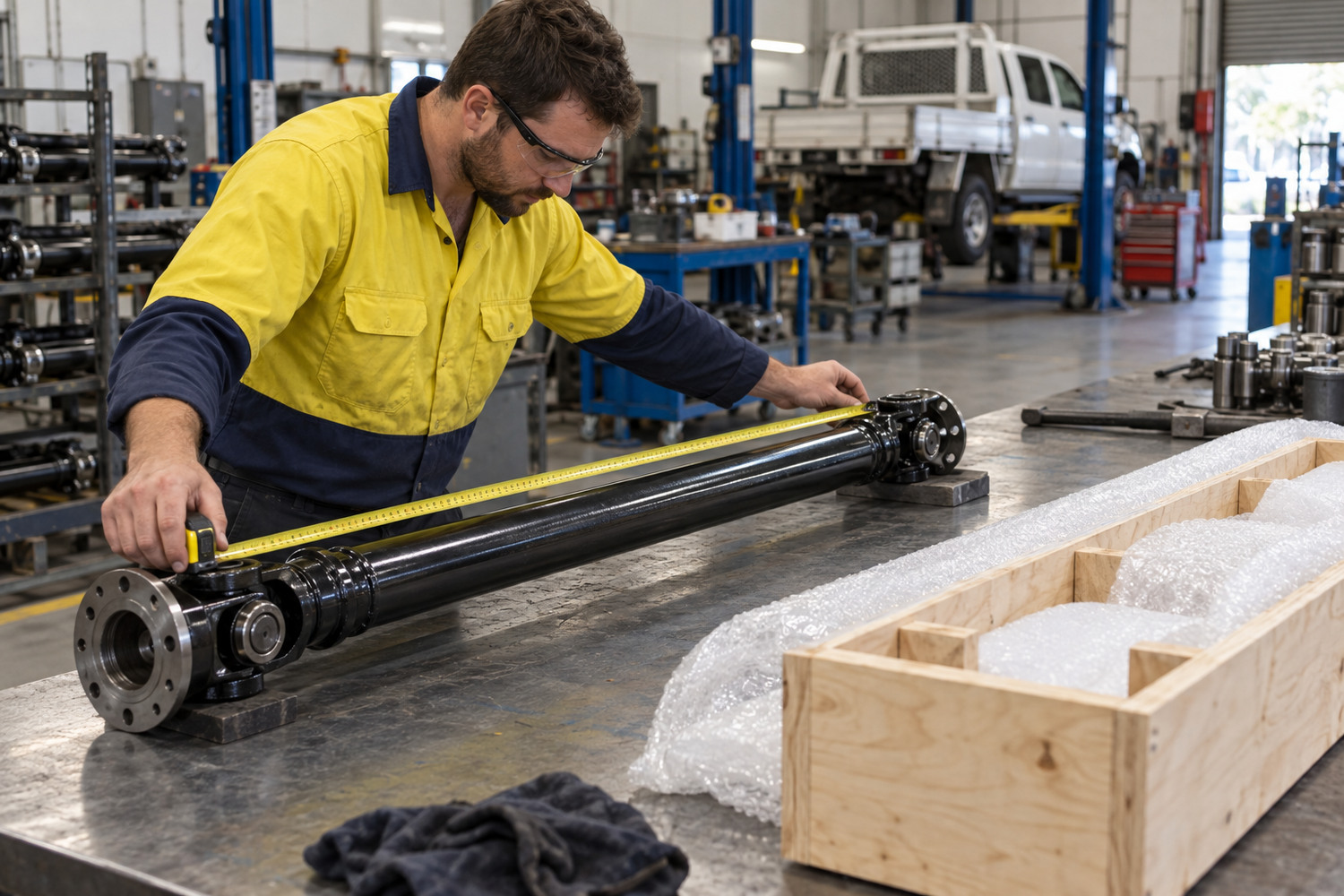
The job runs in four steps. None of them need the vehicle to be present.
Most of the risk sits in the first step. Everything after it is built on what you sent.
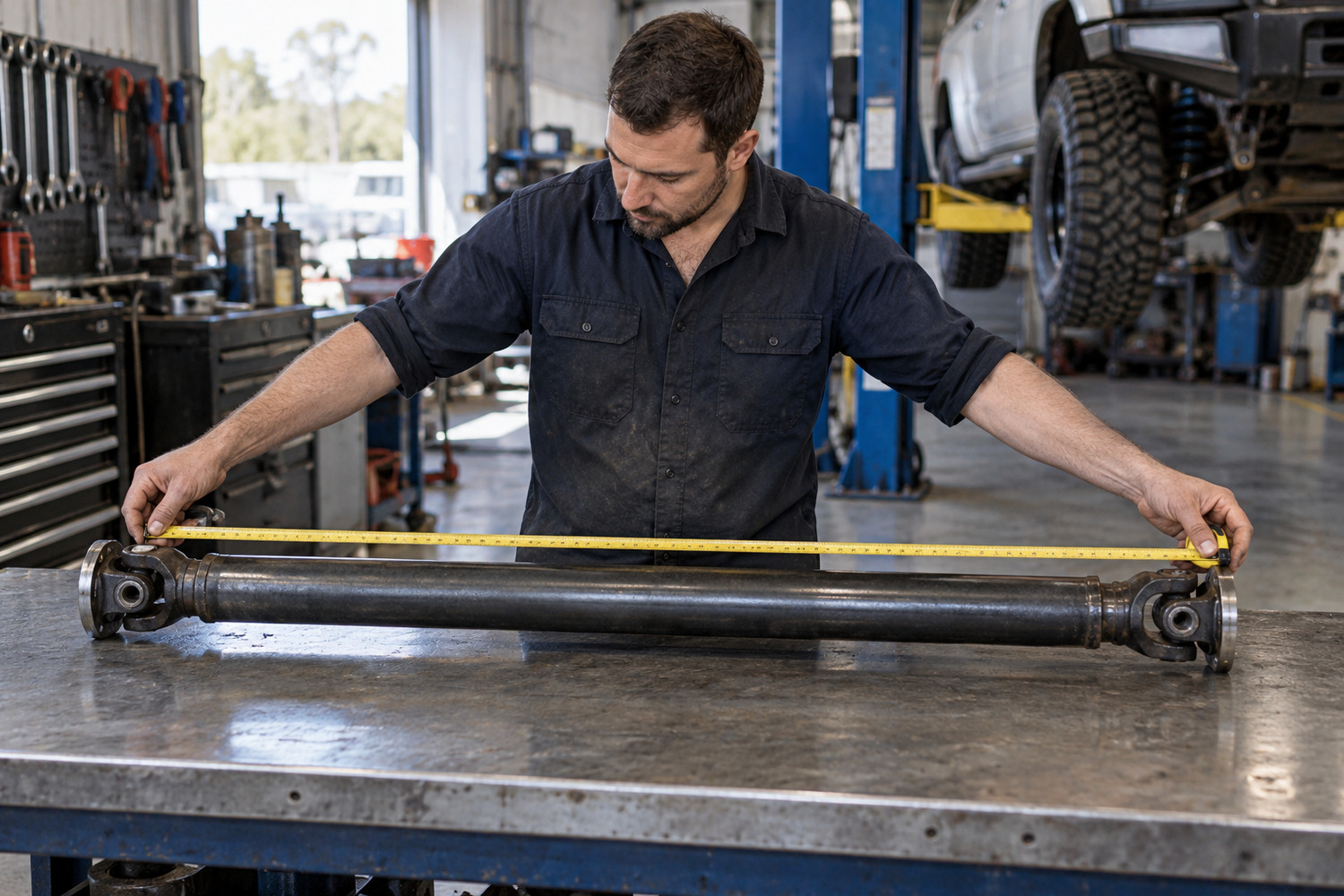
Four things describe a tailshaft. They are its length, the fitting on each end, the bolt pattern where there is a flange, and the diameter of the tube.
A yoke is the forked fitting on the end of a shaft. A universal joint sits inside it. A flange is a flat round plate that bolts to a matching face on the gearbox or the differential. A spigot is the raised or recessed centre on that face. It lines the two halves up before the bolts go in. Tube diameter is the measurement across the outside of the tube.
Which length applies depends on the shaft. It also depends on which parts are being supplied with it. The order form asks for one lettered dimension, W, X, Y or Z. Only one of the four applies to a single shaft. A two piece shaft is the exception. It uses Y plus Z, so that order carries two numbers.
The dimension diagrams live on the site, lettered to match the form. A printable version of the form can be downloaded as well. The numbers can be written down under the car and sent afterwards.
Where either end is a flange, a second form applies. It asks for six details, and all six are required. They are the two centre to centre lengths, the number of bolt holes, the spigot diameter, whether the spigot is male or female, and the bolt hole diameter. A flange with the wrong bolt count or the wrong spacing will not bolt up.
Check which dimension applies against the diagram before the tape comes out. If the shaft in front of you does not match the diagram, ask first.
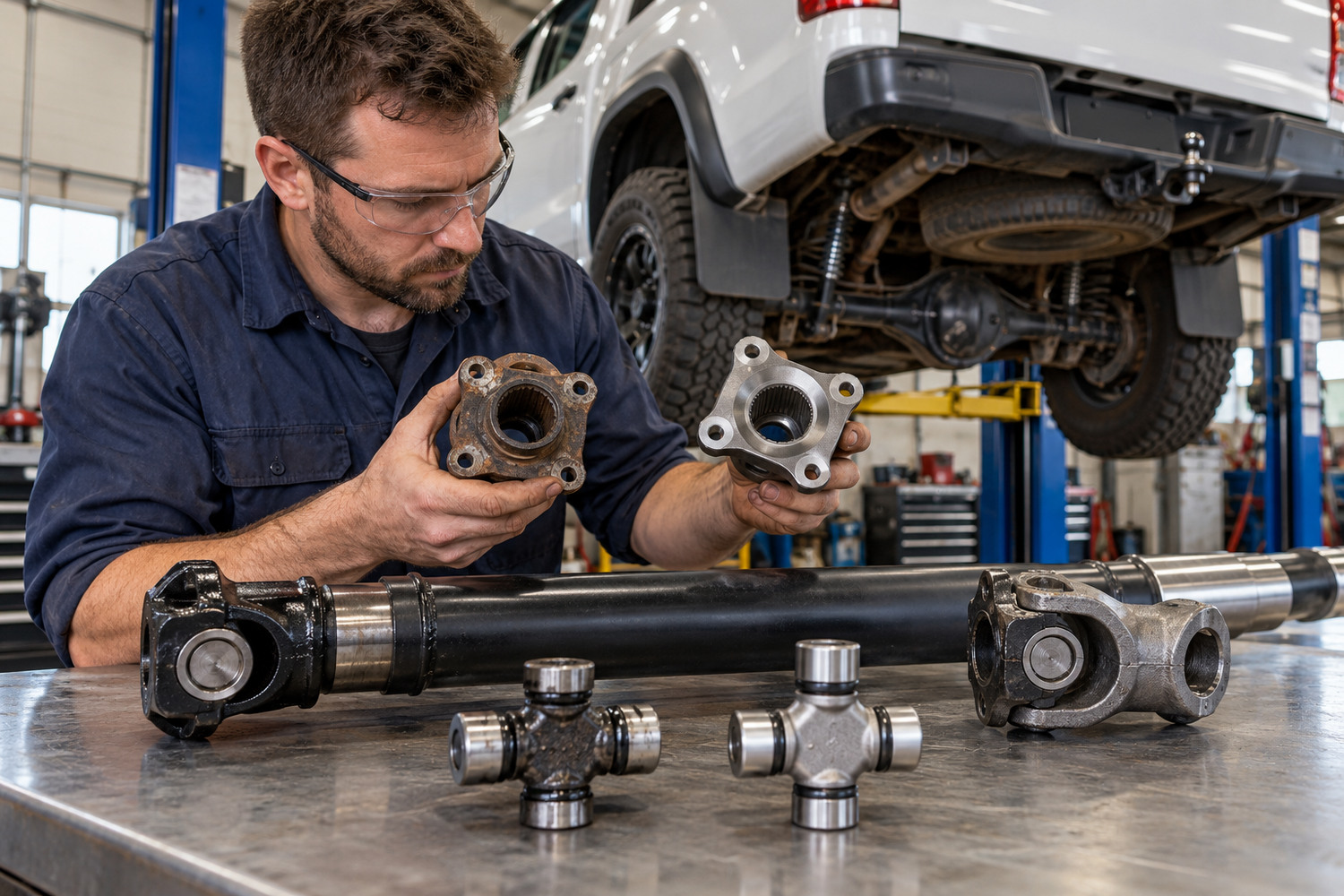
The order form marks seven vehicle fields required. They are the vehicle make, model, engine, RPM, HP or kW, gearbox and differential. It then asks for the rear universal joint and the cup diameter.
Those fields are not paperwork. They decide what the shaft is made from.
Two shafts can be the same length and still need different parts. A ute used for towing and a drag car do not get the same tube, joints or yokes. Engine output and shaft speed are what the tube and the joints have to live with. That is why the form asks for RPM and for horsepower or kilowatts.
The gearbox and the differential decide what the shaft bolts to at each end. The rear universal joint and the cup diameter pin that down at the back. Send all of it, including the fields that feel obvious.
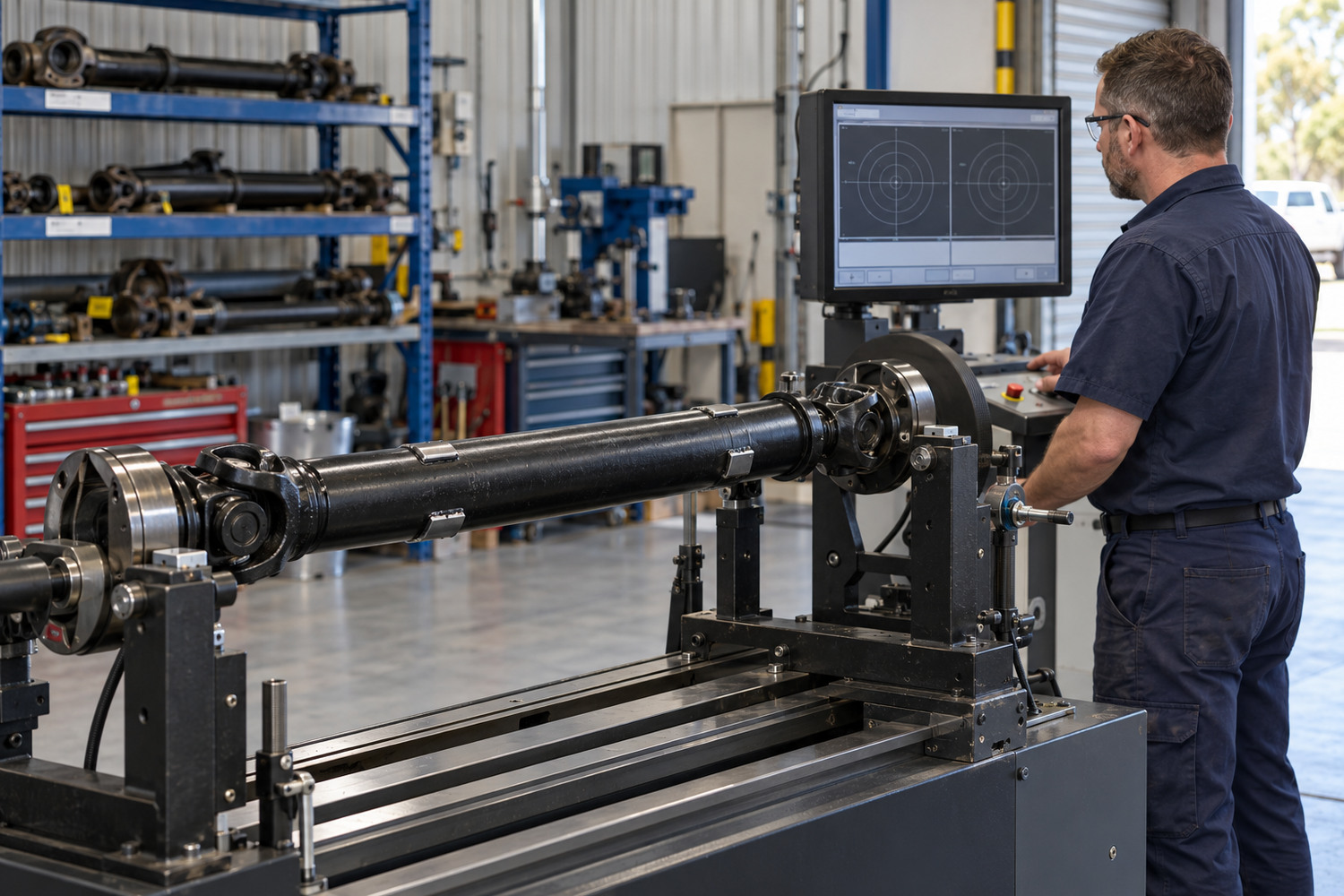
Every tailshaft made or repaired at the workshop is balanced to ISO G16 standards. A digital balancing machine is used, and weights are added as required. That is the workshop’s own published standard.
Balancing matters more on an interstate order. Nobody local has spun the shaft up for you. It leaves balanced rather than arriving as something to sort out.
Freight on a website parts order is a published flat rate. Which rate applies depends on the state it is going to.
The published shipping policy sets $110 for an order containing tailshafts going to New South Wales, Victoria, Tasmania or South Australia. Orders containing tailshafts going to Queensland, the Northern Territory or Western Australia are $165. All other items are $50. So a shaft going to Sydney or Adelaide sits in the lower band. One going to Brisbane or Perth sits in the higher one. Those are the rates as published, and the policy page stays the source of truth.
The same policy says parts orders go out by TNT Express within two business days of the order. That is when the shaft is sent, not when it lands.
The shaft is made and balanced at Keysborough in Melbourne’s south-east, then freighted from there. If the flat rates do not obviously cover your address, the policy invites you to ask about shipping to your location before you buy.
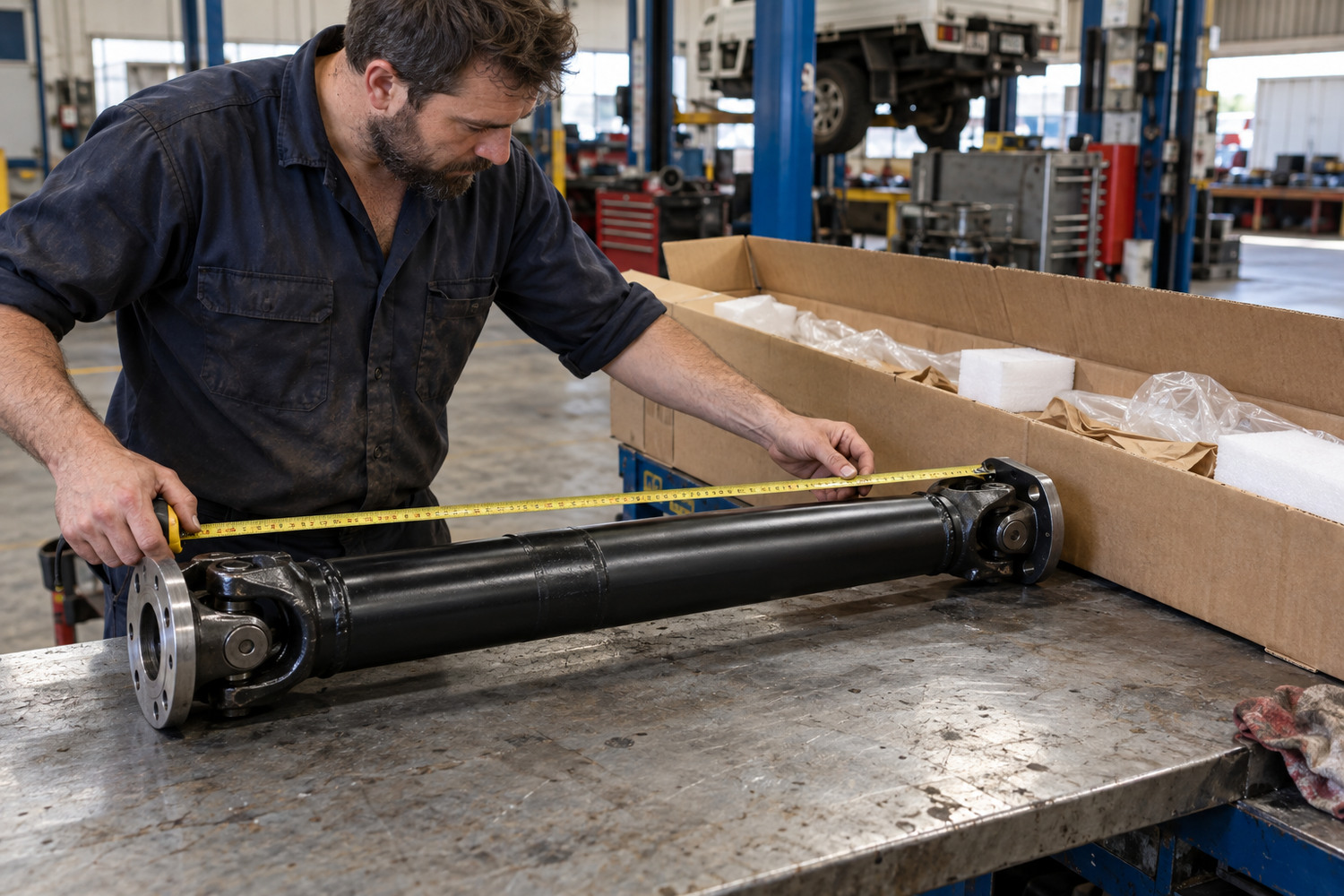
Check the shaft against the numbers that were sent. Do it before it goes anywhere near the car.
Do that before you sign anything off rather than after. Better still, confirm the numbers with the workshop before the shaft is cut.
Send the measurements and the vehicle details through the tailshaft order form. Ask before you buy if anything about your shaft does not match the diagrams. GJ Drivelines builds from the numbers you send, so the numbers are the part worth getting right.
Yes. A shaft is built from written details rather than from the vehicle, so the car never has to leave your state. What the build needs is accurate numbers off it.
The length that applies to your shaft, plus what sits on each end of it. A flange end also needs its bolt holes and its spigot recorded. Tube diameter goes in with them.
A website order with a tailshaft in it going to Queensland is $165 under the published policy, the same as one going to the Northern Territory or Western Australia. Items other than tailshafts are $50. Check the policy page before you buy, because a published rate can change.
Yes. It is balanced as part of the build, not arranged separately afterwards, and ISO G16 is the standard the workshop publishes. On an interstate order that matters, because the first time it turns will be in your car.
Flange work has its own form, and all six of its fields are required. Send the vehicle details with them. If a number is missing, that is the thing to settle before the order is confirmed rather than after.


Chrysler – Dodge
727 – 30 Spline 1 11/16″ Seal Diameter
904 – 26 Spline 1 9/16″ Seal Diameter
Ford
C6-T56 – 31 Spline 1 11/16″ Seal Diameter
AOD & C4 & T5 – 28 Spline 1 1/2″ Seal Diameter
4 R 7OW – 28 Spline 1.598″ Seal Diameter
General Motors
T-350 700R4-4LLOE – 27 Spline 1 1/2″ Seal Diameter
T-400-4L80E – 32 Spline 1 7/8″ Seal Diameter
Note: Transmission slip yokes are manufactured with various U-Joint Series. It is important to match Horsepower and Torque requirements to U-Joint Series. For aftermarket transmission applications usually a spline count and seal diameter will identify slip yoke required.

If Pinion Yoke has Placement tabs that retain the U-Joint, measure inside tabs. See Diagram D.

If Pinion Yoke does not have Placement Tabs that retain U-Joint, measure from flat of yoke inside to inside. See Diagram E.

If 4 bolt Flange is used on pinion, measure Pilot Diameter and center to center diagonally bolt hole to bolt hole. See Diagram L.

Universal Joint Size. There are hundreds of U-Joint sizes or “Series” to accomodate many different applications of power and desired longevity for your automotive, 4×4 truck or auto racing requirements, these 4 series of joints cover most needs.
1310 Spicer Series: 1 1/16″ Cup Diameter (Dim C – Diagram A) 3 7/32″ length (Dim B – Diagram A) Certain Ford applications have 2 cups 1 1/8 Diameter. Appropriate horse power range is up to 500 in circle track or road racing, small tire drag racing and 4×4. Also available: Performance Dynamic Cryo Joint.
1330 Spicer Series: 1 1/16″ Cup Diameter (Dim C – Diagram A) 3 5/8″ length (Dim B – Diagram A) Certain Ford applications have 2 cups 1 1/8 Diameter. Slightly stronger than 1310, Used in 5.0 Mustangs. Also available: Performance Dynamic Cryo Joint.
3R Saginaw Series: 1 1/8″ Cup Diameter (Dim C – Diagram A) Retained with internal clip 2 5/8″ (Dim B – Diagram A). Most common GM joint. Horse power range up to 700 in road racing and circle track. Solid drag racing U-Joint can accomodate most sportsman classes. Also available: Performance Dynamic Cryo Joint.
1350 Spicer Series: Manufactured with OEM tolerances and treated with our Cryogenic Process to yeild the strongest U-Joint available. For drag racing applications a solid non-lube design U-Joint is recommended because of the tremendous initial shock load, or short duration of high torque the joint must be able to withstand.

If PST is supplying you with transmission slip yoke, Pinion yoke and driveshaft yoke measure Dim W. See Diagram N.
If PST is supplying you with transmission slip yoke and driveshaft measure Dim X. See Diagram N.
2 Piece driveshafts use Dim Y + Z. See Diagram N.