No products in the cart.

All Categories
All Categories
external
variable
grouped
simple
[fibosearch]
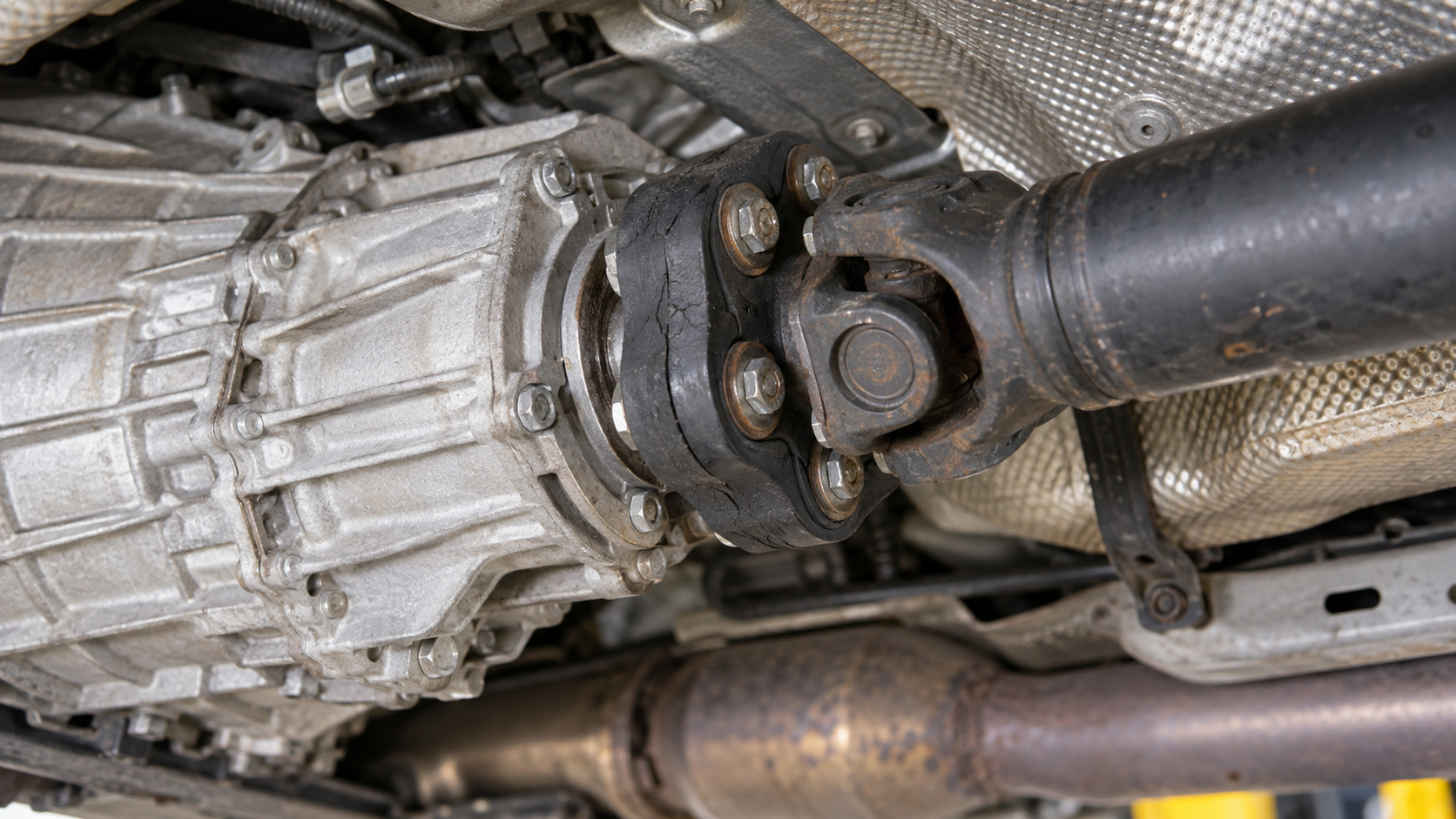
A tailshaft coupling is the flexible rubber disc that bolts between the gearbox output flange and the front of the tailshaft. All of the engine’s drive passes through it, so as the rubber cracks or bulges the car shocks or shudders as drive takes up. The same part is sold as a flexible disc, a rag joint, a doughnut coupling and a giubo.
A flange is the flat round plate on the end of the gearbox that the shaft bolts to. The tailshaft is the spinning tube that carries drive back to the differential.
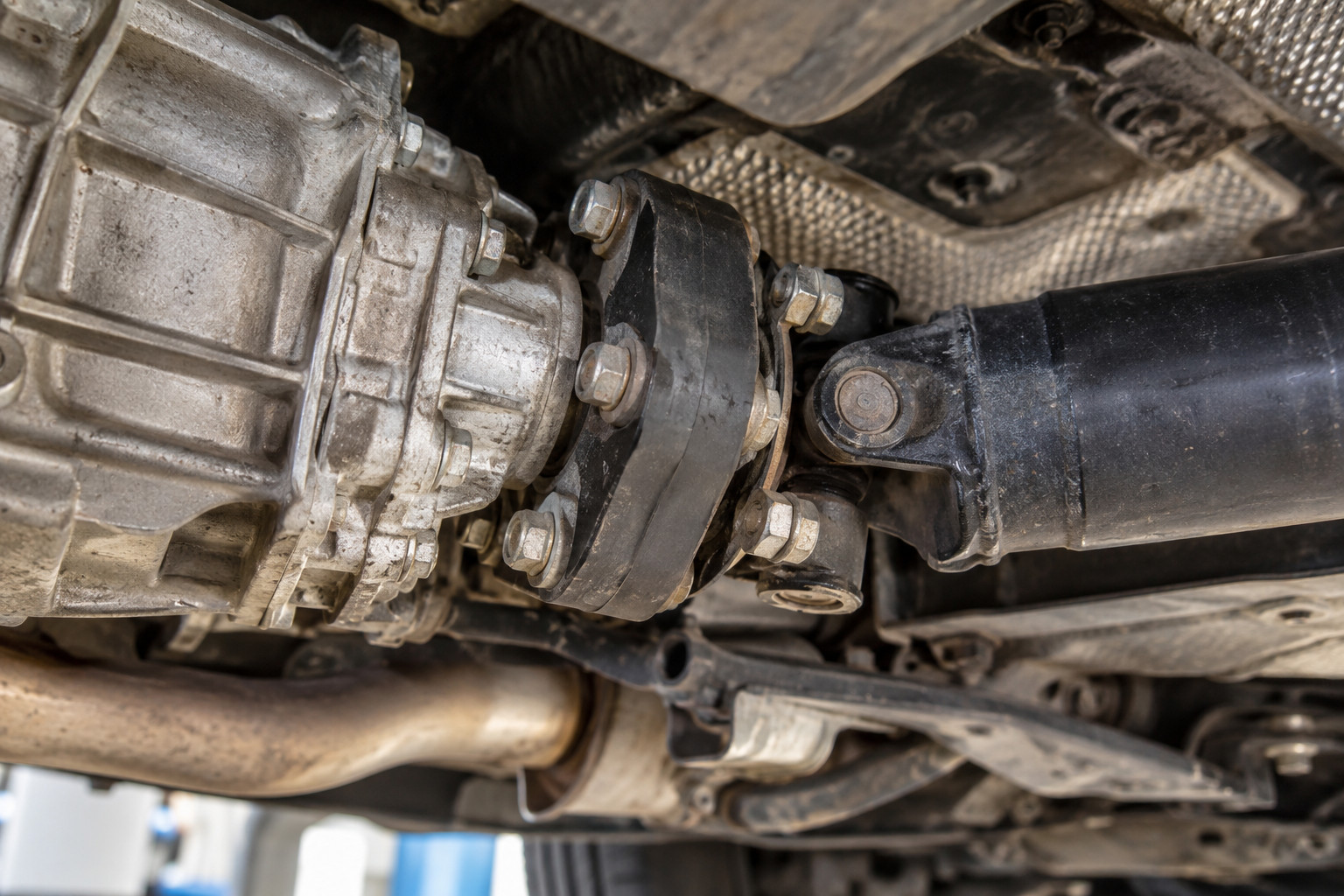
The coupling does two jobs. It joins the gearbox to the front of the shaft, and it lets the angle between them change. That angle moves constantly, because the suspension works over the road while the shaft turns.
The second job is damping. The disc soaks up shock and load changes instead of letting every torque peak run straight into the driveline. Manufacturers of the part describe it as absorbing shock and load forces and preventing harmful misalignment.
It is not a universal joint, although the names sometimes get mixed up. A universal joint is a different part on the same shaft.
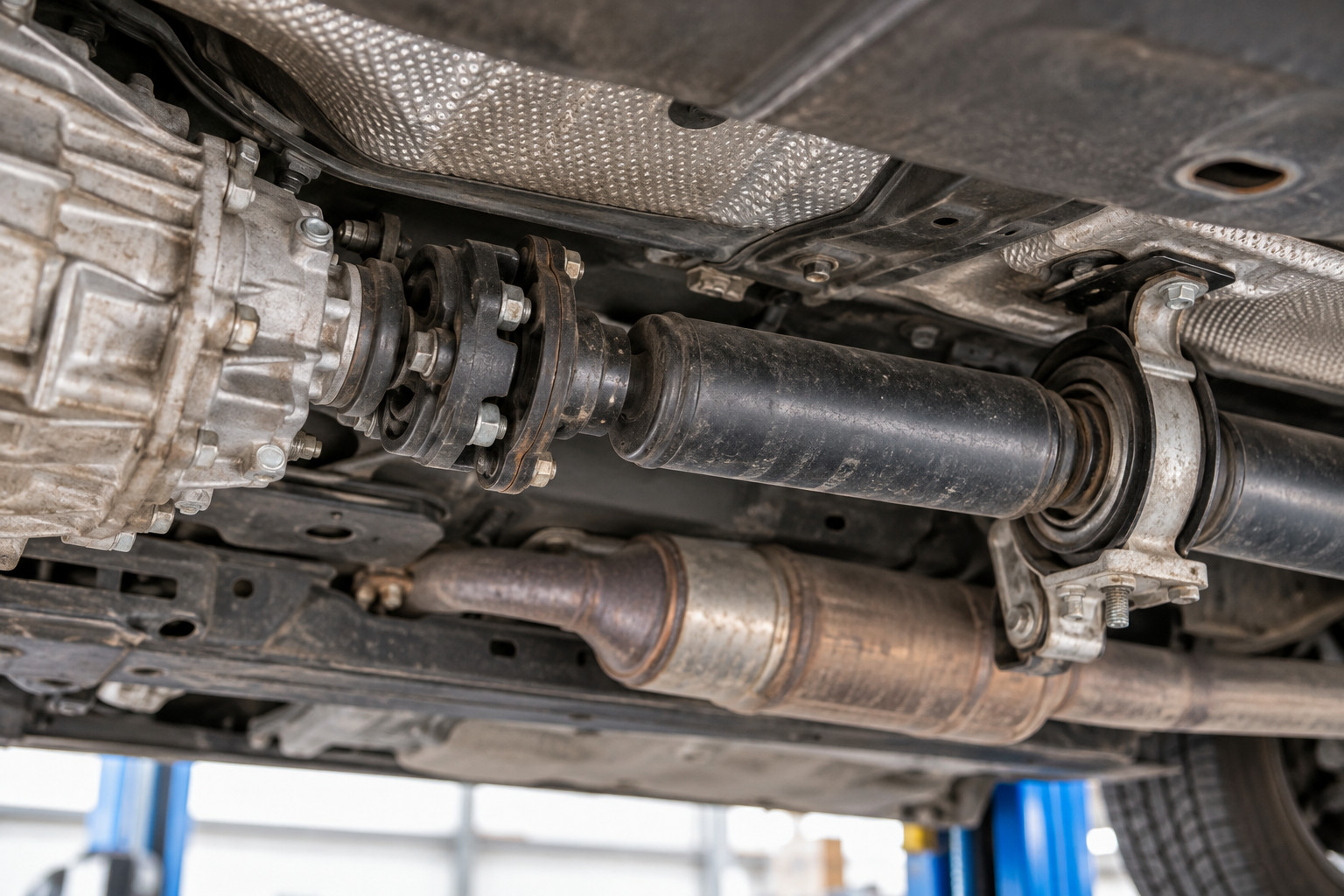
Coupling wear shows up under load, as a shock or a shudder while drive takes up. It arrives from a standing start, or as you get back on the throttle. Manufacturers of the part describe wear as vibrations or shocks in the driveline that can increase during acceleration.
That feeling is not proof the coupling is the culprit. A worn centre bearing gives much the same complaint. The centre bearing is the rubber mounted support in the middle of a two piece shaft. Worn universal joints can show up as a clunk as you take up drive.
The coupling and the joints sit in the drive path, so wear in them arrives with load. A centre bearing is a mount, so it reads as a drone or hum that tracks road speed rather than throttle. If you are chasing general tailshaft vibration rather than a take-up shudder, start there.
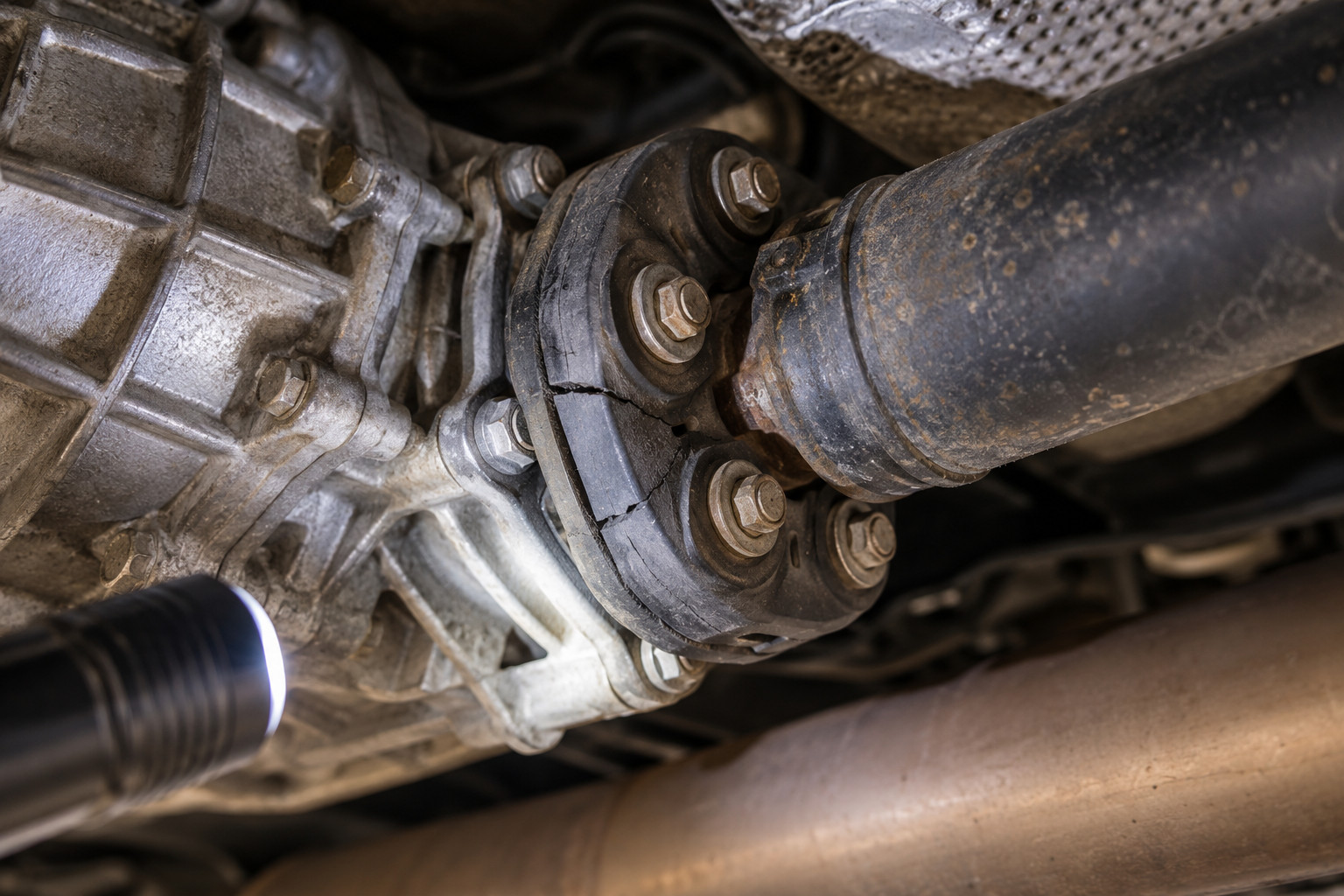
A worn tailshaft coupling is found by eye, and any of these condemns it:
Any cracking or bulging means the disc is defective, and the part’s manufacturer says replacement should follow. One in that state is not something to watch.

The coupling is a catalogued part for these cars, supplied on its own. The Hardy Spicer driveline catalogue lists rubber drive couplings for BA and BF Falcon six cylinder and Territory. It lists them for BA and BF Falcon Series I, and as a high torque upgrade covering BA through FG. There is a listing for BF Falcon Series II onward, FG Falcon and Territory, plus a bolt kit for Falcon and Territory.
More than one coupling is catalogued. They differ in outside diameter and in bolt hole spacing. So the badge on the boot does not settle which coupling the car takes. The part is matched to the car by series and engine.
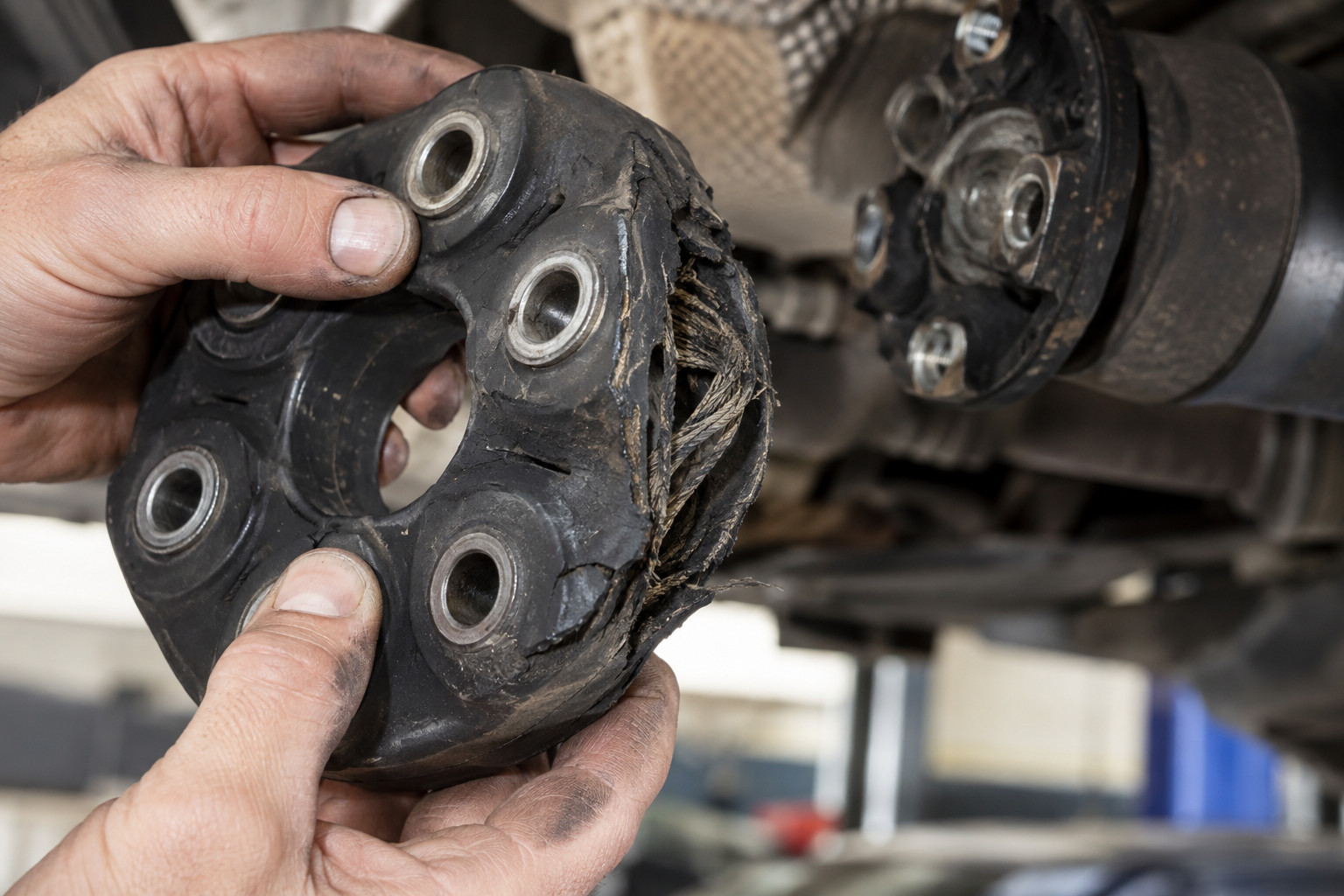
A tailshaft coupling is a heavily stressed part. That is the part manufacturer’s own reason for saying it should be checked at regular maintenance intervals.
Power crosses the disc almost entirely through cords moulded inside it, which carry the load in tension. The rubber protects those cords and keeps noise out of the car. So the rubber is the part that ages.
Stop-start driving across Melbourne’s south-east is the duty cycle that finds a tired coupling. It is drive taken up and let off again all day.
A new coupling on a tired shaft is a false economy. The part’s manufacturer says to check four things while the coupling is off. They are the shaft’s centring guide bush, the mating faces, the pin bores and the bolt threads. A worn one there can leave the shaft vibrating with a new disc fitted.
The bolts are a replacement item too. The same guidance is to fit new fixing screws and tighten them to the vehicle manufacturer’s figures. A bolt kit is catalogued for these cars beside the couplings.
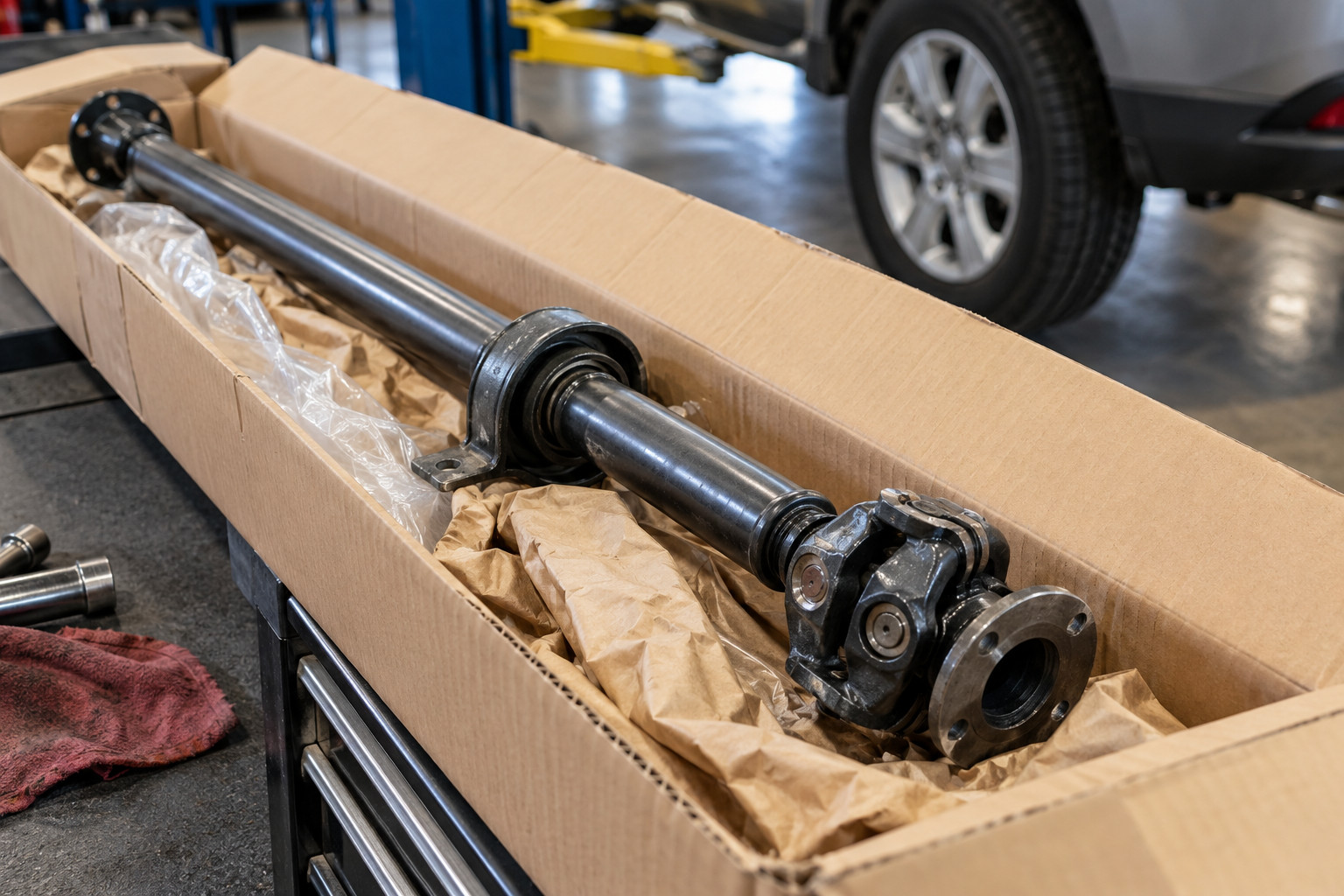
Sometimes the whole shaft is the cleaner answer. The store lists three complete Territory tailshafts. The rear assembly for the SZ and SZ MkII diesel arrives complete. It comes with the centre bearing, the CV joint, the rubber coupling and all the bolts and mounting hardware, under a stated twelve month warranty. A CV joint is a constant velocity joint, which keeps turning smoothly as the angle at its end changes. Where the bearing and the joint are tired along with the coupling, one assembly covers all three.
A Falcon is a different conversation. No coupling is listed on its own in the store. That job starts with an inspection rather than a part in a cart. The published offer on the shaft is a quote and inspection, free of charge with no obligation.
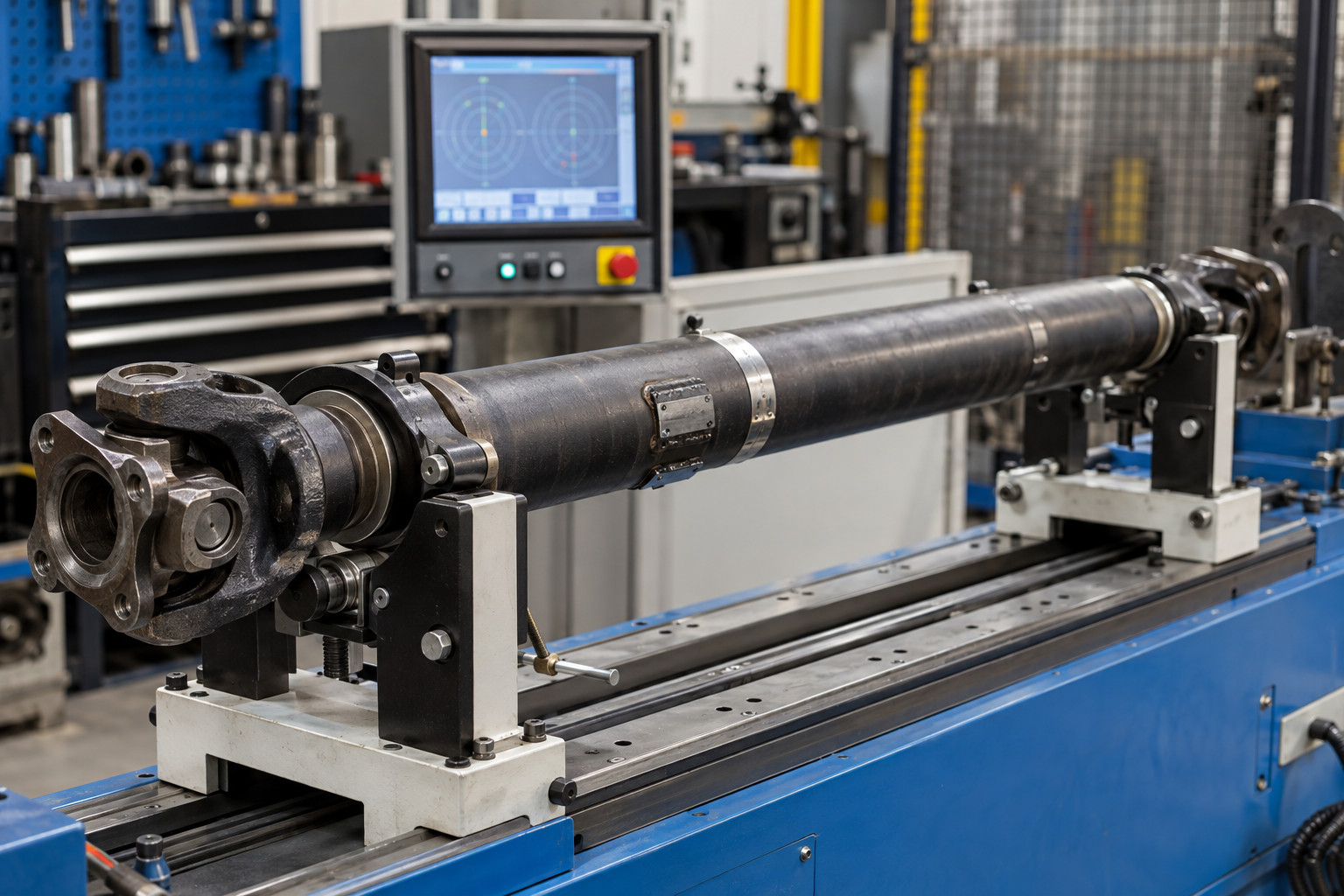
Every shaft the workshop makes or repairs is balanced to ISO G16. That is the standard it publishes. A Schenk digital balancing machine is used, with weights added as required. The same published list adds digital high speed balancing of all tailshafts after a centre bearing replacement.
There is a post on the site explaining why balancing matters. What matters here is the order: the shaft is balanced after the new parts go in.
If the car shocks or shudders as drive takes up, have the shaft looked at before buying a part for it. Have the vehicle details ready, because the enquiry form asks for the make, model, engine, RPM, power output, gearbox and differential. GJ Drivelines works from those details.
It is a disc of rubber and fabric bolted between the gearbox and the shaft that drives the rear wheels. It hands the drive along, and it flexes so the two ends can sit at changing angles. Trade names include the giubo, the rag joint and the doughnut.
Every bit of drive the engine produces crosses this one disc. Its manufacturer treats a cracked or bulging disc as defective, which means replacement rather than monitoring. Book it in rather than waiting to see what happens.
More than one part can cause that on these cars. It might be the coupling, the support bearing in the middle of the shaft, or worn joints. The symptom on its own does not name the part, so an inspection is what settles it.
It is a bolted joint between two flanges, and how much work that means depends on the vehicle. An inspection answers it for your car. While the disc is off, the guide bush and the faces it mates to want a look. So do the bores for the pins and the threads for the bolts.
Notice what brings the trouble on. A worn coupling tends to speak up when drive is applied, pulling away or accelerating. A tired centre bearing hums or drones in step with road speed. It holds the shaft up rather than passing drive through it.


Chrysler – Dodge
727 – 30 Spline 1 11/16″ Seal Diameter
904 – 26 Spline 1 9/16″ Seal Diameter
Ford
C6-T56 – 31 Spline 1 11/16″ Seal Diameter
AOD & C4 & T5 – 28 Spline 1 1/2″ Seal Diameter
4 R 7OW – 28 Spline 1.598″ Seal Diameter
General Motors
T-350 700R4-4LLOE – 27 Spline 1 1/2″ Seal Diameter
T-400-4L80E – 32 Spline 1 7/8″ Seal Diameter
Note: Transmission slip yokes are manufactured with various U-Joint Series. It is important to match Horsepower and Torque requirements to U-Joint Series. For aftermarket transmission applications usually a spline count and seal diameter will identify slip yoke required.

If Pinion Yoke has Placement tabs that retain the U-Joint, measure inside tabs. See Diagram D.

If Pinion Yoke does not have Placement Tabs that retain U-Joint, measure from flat of yoke inside to inside. See Diagram E.

If 4 bolt Flange is used on pinion, measure Pilot Diameter and center to center diagonally bolt hole to bolt hole. See Diagram L.

Universal Joint Size. There are hundreds of U-Joint sizes or “Series” to accomodate many different applications of power and desired longevity for your automotive, 4×4 truck or auto racing requirements, these 4 series of joints cover most needs.
1310 Spicer Series: 1 1/16″ Cup Diameter (Dim C – Diagram A) 3 7/32″ length (Dim B – Diagram A) Certain Ford applications have 2 cups 1 1/8 Diameter. Appropriate horse power range is up to 500 in circle track or road racing, small tire drag racing and 4×4. Also available: Performance Dynamic Cryo Joint.
1330 Spicer Series: 1 1/16″ Cup Diameter (Dim C – Diagram A) 3 5/8″ length (Dim B – Diagram A) Certain Ford applications have 2 cups 1 1/8 Diameter. Slightly stronger than 1310, Used in 5.0 Mustangs. Also available: Performance Dynamic Cryo Joint.
3R Saginaw Series: 1 1/8″ Cup Diameter (Dim C – Diagram A) Retained with internal clip 2 5/8″ (Dim B – Diagram A). Most common GM joint. Horse power range up to 700 in road racing and circle track. Solid drag racing U-Joint can accomodate most sportsman classes. Also available: Performance Dynamic Cryo Joint.
1350 Spicer Series: Manufactured with OEM tolerances and treated with our Cryogenic Process to yeild the strongest U-Joint available. For drag racing applications a solid non-lube design U-Joint is recommended because of the tremendous initial shock load, or short duration of high torque the joint must be able to withstand.

If PST is supplying you with transmission slip yoke, Pinion yoke and driveshaft yoke measure Dim W. See Diagram N.
If PST is supplying you with transmission slip yoke and driveshaft measure Dim X. See Diagram N.
2 Piece driveshafts use Dim Y + Z. See Diagram N.