No products in the cart.

All Categories
All Categories
external
variable
grouped
simple
[fibosearch]
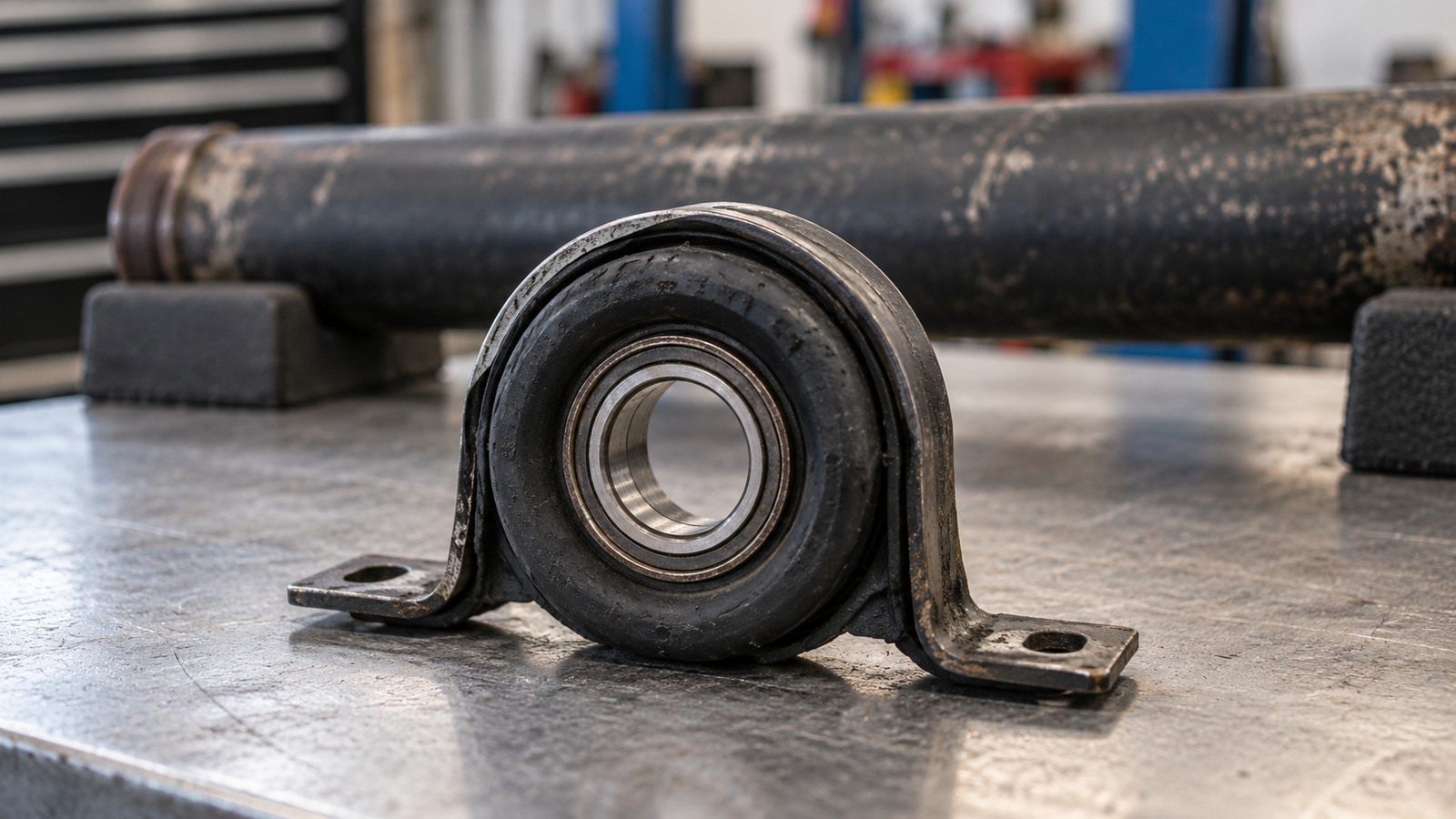
A worn Ford Territory tailshaft centre bearing can leave the car droning or shaking. So can the rubber support that holds it. The noise on its own cannot name the part that failed. The cause needs assessment of the actual driveline. Vehicle details and shaft position matter when identifying the assembly; the Territory badge alone does not establish the part.
Say you are heading home down EastLink and something under the floor has changed. There is a hum, or a shake through the seat, that was not there last month. You cannot see the tailshaft from the driver’s seat. So the only real question is what to have looked at.
In a supported two-piece shaft, the centre bearing supports the rotating assembly through a bearing, rubber isolation and a mounting bracket. It is not simply a joining piece. The exact arrangement still needs to be identified on the vehicle. There is already a post on the signs of centre bearing wear and when the part gets replaced.

A change in noise or vibration is a reason to have the driveline inspected. On its own it is not a diagnosis, and it does not need to be.
You do not have to work out the cause before you ring anybody. What helps is a plain description. Say what you can hear, when it started, and what the car is doing at the time. That is the owner’s half of the job.
Several parts under a Territory can make a noise the driver notices. The tailshaft is one of them. The post on tailshaft centre bearing noise sets out the wider spread of driveline sounds. Its wider symptom discussion does not establish which component has failed on your vehicle.
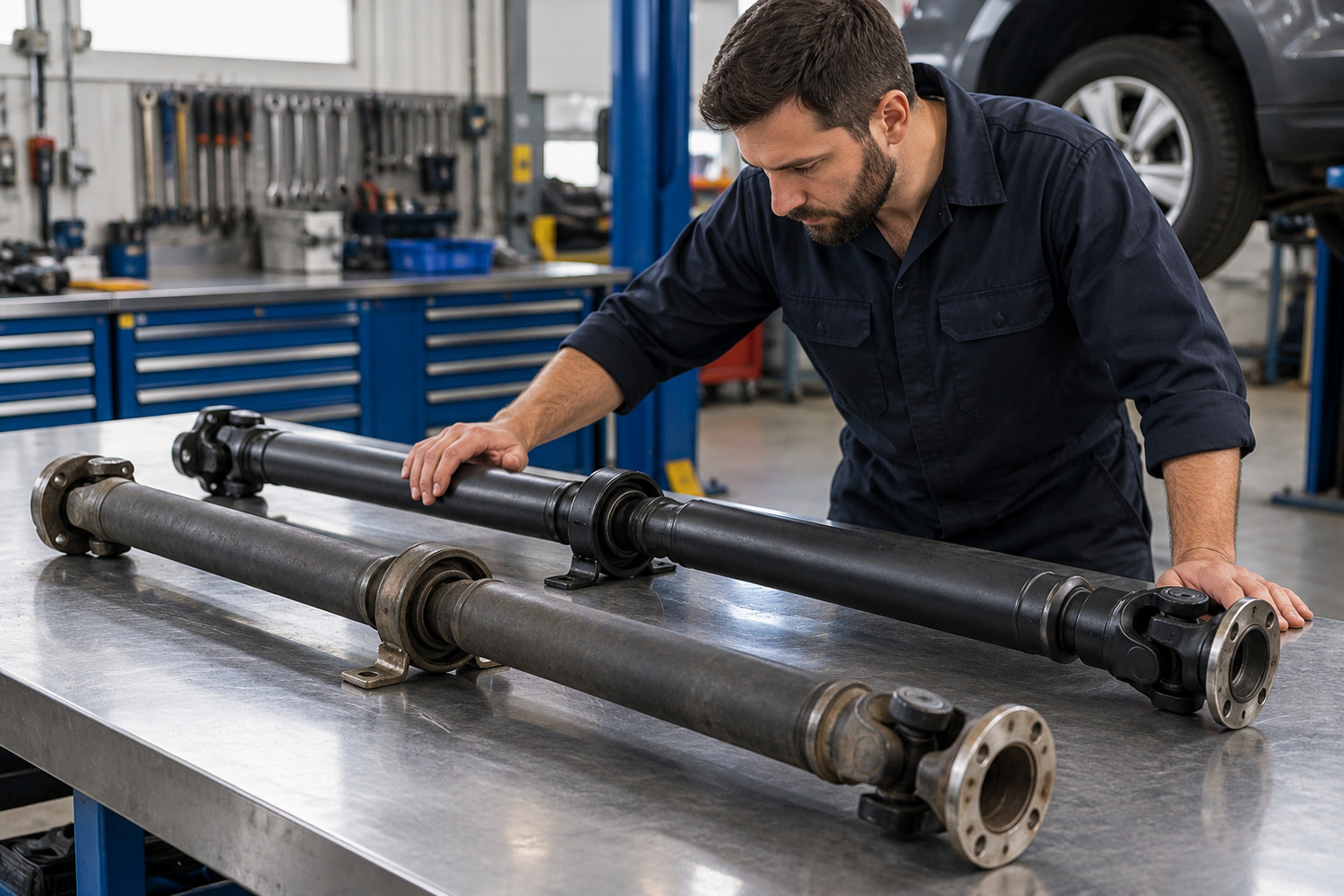
The current GJ listings distinguish two diesel rear assemblies from a front shaft. They describe SZ and SZ MkII applications from the stated February 2011 build range, with a 2.7 litre V6 diesel engine and right-hand drive. Those published limits matter; they do not establish petrol, SX or SY fitment.
The listing descriptions help separate these purchasing options. They are not evidence that every Territory has the same shaft arrangement or that a particular assembly is currently available. Identify the actual shaft position and confirm the complete application before using a description to choose a part.
Engine and series change which Ford Territory tailshaft centre bearing fits. Hardy Spicer’s driveshaft component catalogue, issue 20 of 1 November 2022, lists the Territory centre bearing support in three separate rows. One row covers SX, SY and SZ petrol. A second covers the SZ diesel from 2011. A third is a rubber and bearing only option, for a diesel that keeps its original bracket.
The catalogue also says its figures are nominal. It takes no responsibility for an unsuitable part being fitted. Read it as a reason to confirm the application against your own vehicle, rather than as a shortcut past that step.
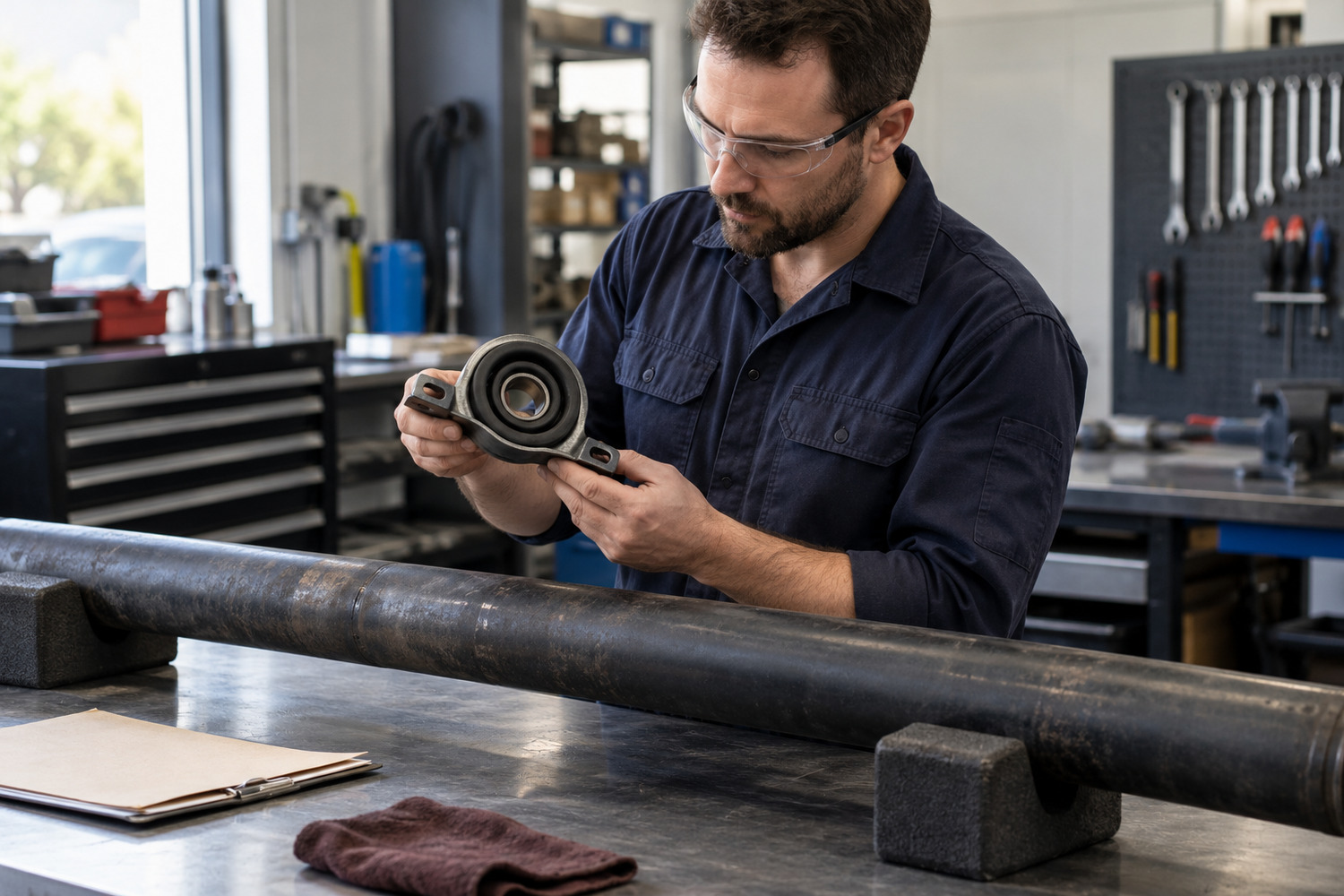
A bearing repair and a complete assembly replacement cover different work. Replacing the bearing keeps the shaft you already have. That only makes sense if the rest of the shaft is worth keeping.
An inspection is what answers it. The assessment needs to consider the other components as well as the bearing. Replacing one component does not establish that another source of noise or vibration has been corrected.
The rubber coupling is worth a thought of its own. The two listed rear diesel assemblies include a rubber coupling alongside the centre bearing and joint. The post on tailshaft coupling wear on a Falcon or Territory discusses that separate component; a symptom still does not identify it as the failed part.
A complete assembly is supplied as a set of the listed components. Fitting it is still work on the vehicle, so the purchase and installation need to be considered separately. That gives a different scope of replacement, but suitability still depends on the actual application and the condition being addressed.
Neither option is automatically better or cheaper. A general description does not establish that a bearing repair is sufficient or that a complete assembly is necessary.
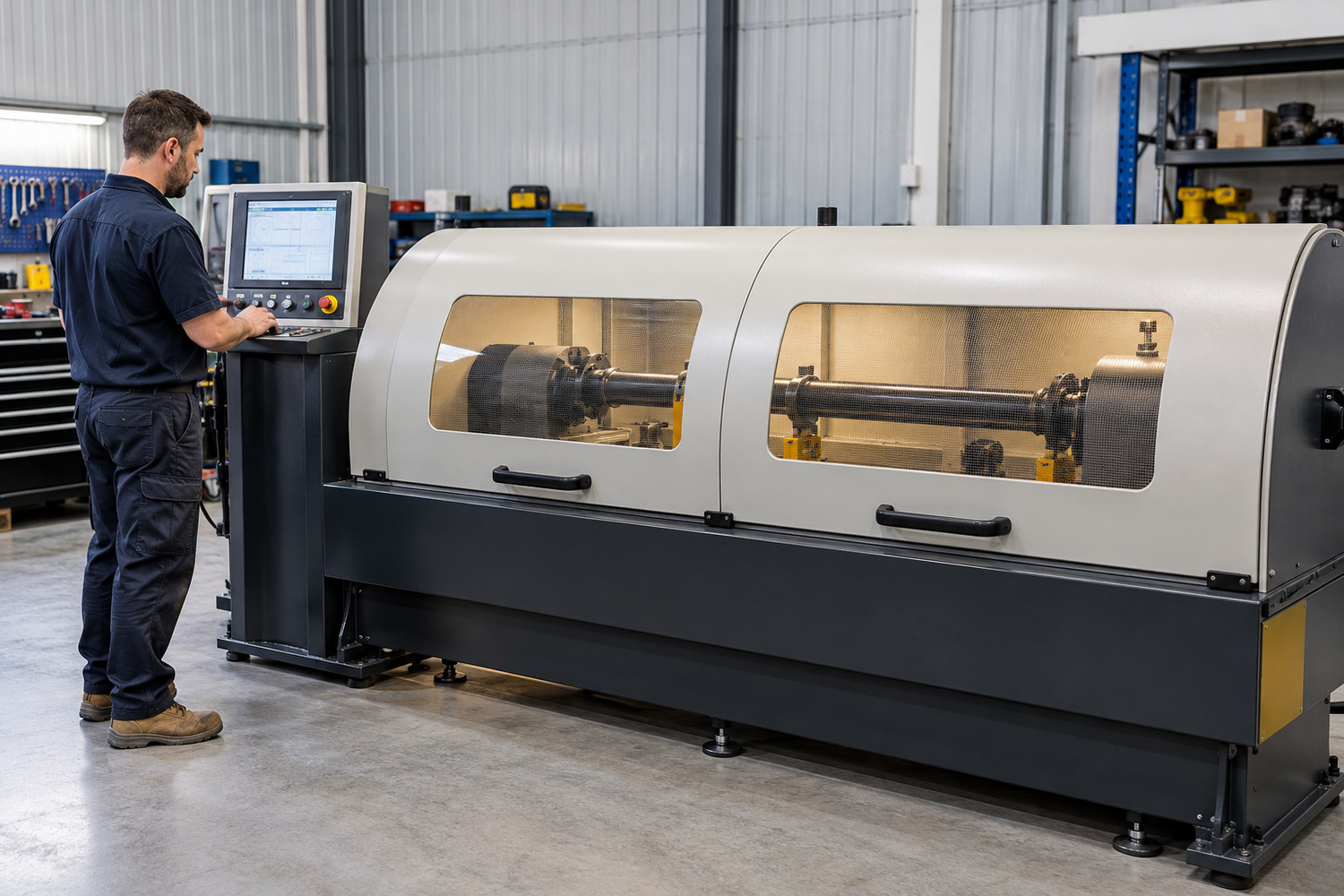
The published centre bearing service states that all tailshafts are balanced after a centre bearing replacement, on a digital high speed machine. That is a statement about its published centre-bearing service, not a detailed instruction for carrying out the work.
It is the workshop’s own stated process rather than a rule that applies to every replacement shaft. There is a separate post on why balancing matters to the way a car drives.

Two routes are open. Both of them start with the vehicle rather than with the part.
If the noise or the shake is the problem, have the shaft inspected before buying a Ford Territory tailshaft centre bearing. The published offer on a tailshaft is a quote and inspection, free of charge with no obligation. A description of noise does not establish a safe driving interval or that the change can be ignored. Seek advice on the actual condition and how the vehicle should be assessed.
If you already know which shaft you need, have the listing matched to your vehicle first. Keep the make, model, engine and driveline to hand. Say whether it is the front or the rear shaft, too. Ordering from another state has steps of its own, and the post on ordering a custom tailshaft from interstate walks through them.
GJ Drivelines works from those vehicle details rather than from the model name alone. Have them in front of you and get a quote.
Noise or vibration can be a reason to investigate the driveline, but it cannot identify the centre bearing by itself. Describe the change you have noticed and seek assessment rather than treating a particular sound as a confirmed diagnosis.
A bearing repair may be appropriate if the actual assembly and its remaining components are suitable for it. A listed complete assembly replaces a different set of components. Assessment and application confirmation come before choosing between them.
The required work depends on the actual shaft and applicable technical instructions. This guide provides no removal procedure. Have the method confirmed for the vehicle rather than assuming that one answer covers every Territory.
Nobody can promise you that from a description of the noise. Have the driveline looked at. Let the person who has seen the shaft tell you where it stands.


Chrysler – Dodge
727 – 30 Spline 1 11/16″ Seal Diameter
904 – 26 Spline 1 9/16″ Seal Diameter
Ford
C6-T56 – 31 Spline 1 11/16″ Seal Diameter
AOD & C4 & T5 – 28 Spline 1 1/2″ Seal Diameter
4 R 7OW – 28 Spline 1.598″ Seal Diameter
General Motors
T-350 700R4-4LLOE – 27 Spline 1 1/2″ Seal Diameter
T-400-4L80E – 32 Spline 1 7/8″ Seal Diameter
Note: Transmission slip yokes are manufactured with various U-Joint Series. It is important to match Horsepower and Torque requirements to U-Joint Series. For aftermarket transmission applications usually a spline count and seal diameter will identify slip yoke required.

If Pinion Yoke has Placement tabs that retain the U-Joint, measure inside tabs. See Diagram D.

If Pinion Yoke does not have Placement Tabs that retain U-Joint, measure from flat of yoke inside to inside. See Diagram E.

If 4 bolt Flange is used on pinion, measure Pilot Diameter and center to center diagonally bolt hole to bolt hole. See Diagram L.

Universal Joint Size. There are hundreds of U-Joint sizes or “Series” to accomodate many different applications of power and desired longevity for your automotive, 4×4 truck or auto racing requirements, these 4 series of joints cover most needs.
1310 Spicer Series: 1 1/16″ Cup Diameter (Dim C – Diagram A) 3 7/32″ length (Dim B – Diagram A) Certain Ford applications have 2 cups 1 1/8 Diameter. Appropriate horse power range is up to 500 in circle track or road racing, small tire drag racing and 4×4. Also available: Performance Dynamic Cryo Joint.
1330 Spicer Series: 1 1/16″ Cup Diameter (Dim C – Diagram A) 3 5/8″ length (Dim B – Diagram A) Certain Ford applications have 2 cups 1 1/8 Diameter. Slightly stronger than 1310, Used in 5.0 Mustangs. Also available: Performance Dynamic Cryo Joint.
3R Saginaw Series: 1 1/8″ Cup Diameter (Dim C – Diagram A) Retained with internal clip 2 5/8″ (Dim B – Diagram A). Most common GM joint. Horse power range up to 700 in road racing and circle track. Solid drag racing U-Joint can accomodate most sportsman classes. Also available: Performance Dynamic Cryo Joint.
1350 Spicer Series: Manufactured with OEM tolerances and treated with our Cryogenic Process to yeild the strongest U-Joint available. For drag racing applications a solid non-lube design U-Joint is recommended because of the tremendous initial shock load, or short duration of high torque the joint must be able to withstand.

If PST is supplying you with transmission slip yoke, Pinion yoke and driveshaft yoke measure Dim W. See Diagram N.
If PST is supplying you with transmission slip yoke and driveshaft measure Dim X. See Diagram N.
2 Piece driveshafts use Dim Y + Z. See Diagram N.